Wheat Farming in the UK Super El Niño
The El Niño itself is near-certain and record-strength. What it does to UK weather is far less certain. This assessment is general guidance and Messium's opinion - it does not constitute professional advice.
We are writing this at the end of a severe drought summer, which is an odd position from which to warn anyone about a wet winter.
Last week the Met Office published its assessment of the developing El Niño and used the word 'unprecedented'. Professor Adam Scaife, who heads long range forecasting there, said "I have never seen an El Niño signal this intense in our forecasts". Dr. Nick Dunstone, a Science Fellow at the Met Office, expects 2027 to overtake 2024 as the warmest year on record globally.
Messium has been keeping an eye on ECMWF (European Centre for Medium-Range Weather Forecasts) weather forecasts to understand how weather patterns are shifting. The current odds of a strong event between October and January are at 95%. The UK effects of El Niño are indirect so hard to predict exactly, but it raises the odds of:
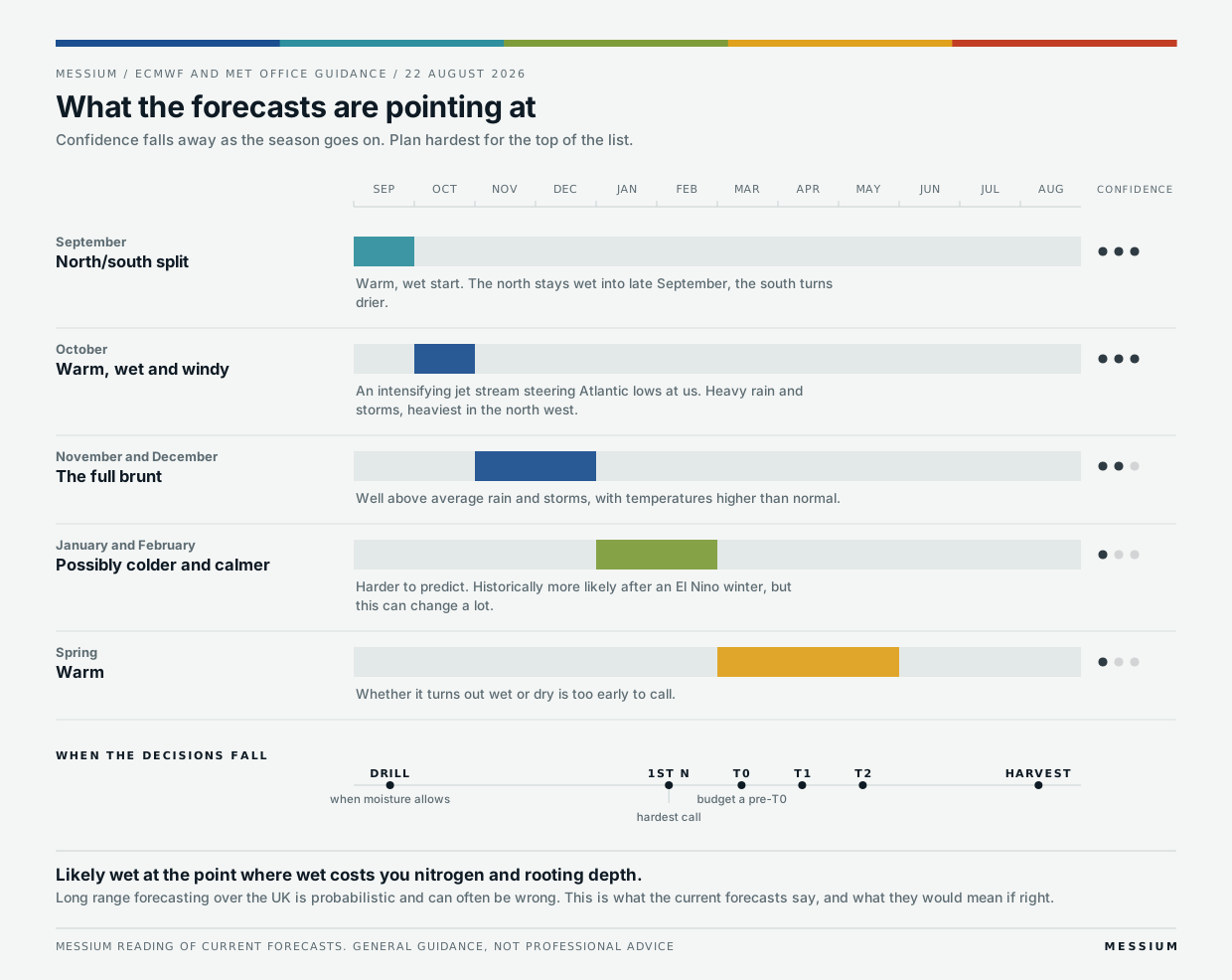
- A big North/South divide in September. Wetter and warmer than average start. The North is expected to continue being wet into late September but the South is expected to be drier.
- A warmer, wetter and windier autumn (October). October is expected to be warmer, wetter and windier than average. A powerful, intensifying jet stream is predicted to steer major Atlantic low-pressure systems towards the UK. This makes extended periods of heavy rain and severe storms highly likely throughout October, particularly in the North West. It'll be a low pressure system meaning despite the average being warmer and wetter, there can be sudden shifts from week to week.
- Intense early winter (November & December). The full brunt of El Niño is expected to hit in November and December. Currently expecting well above average rains & storms, with temperatures being higher than normal.
- Harder to predict, but potentially a colder, calmer late winter (January & February). This can change a lot but historically, we are more likely to have a colder than average January & February following El Niño winters.
- Early indications show a warm Spring. Currently no indication on whether it will be a wet or dry Spring. Too early to predict.
Two things follow from that:
The first is that the season is likely to be wet at exactly the point where wetness costs you nitrogen and rooting depth.
The second is that some of this may not happen at all. Long range forecasting over the UK is probabilistic and can often be wrong. We are predicting future UK weather based on how currents are changing in the North Atlantic, which affects the UK indirectly. This article does not tell you what the weather will do, it only tells you what the current forecasts say and what these mean if they are right.
The argument for early drilling (moisture-permitting)
The straightforward argument for going earlier is that if the wet period arrives on schedule, the back end of the drilling window may simply not exist. Anyone who sat out the autumn of 2019 or 2023 knows how that goes.
The less obvious argument is vernalisation. Winter wheat needs to accumulate cold before it will switch over to reproductive growth, and a winter running several degrees above average delivers that slowly. The crop needs more calendar time in the ground to get there. Drill late into a mild winter and you can end up with something that is still not ready in early spring, which is the last thing you want if you end up with a dry April and May.
The awkward part is the severe drought we are currently in. The National Drought Group's position this month is that autumn rainfall is unlikely to be enough for recovery before December, so early September could easily mean drilling into dry seedbeds with patchy establishment. So the trigger has to be moisture rather than the calendar. We advise being set up to go early, and to go as soon as there is enough moisture to establish, rather than holding for a date.
The argument against early drilling
A bigger canopy going into a warm, wet winter is a good home for septoria. A warmer autumn means more aphid generations and a longer migration window landing on crops that came up earlier, so BYDV might need a deeper plan than a single aphicide.
The yellow rust issue & wheat varieties to pick
Recommended List yellow rust ratings measure adult plant resistance. They describe how a variety behaves from stem extension onwards. At the young plant stage most RL varieties are susceptible, and RGT Guardsman is currently the only one on the list classified as resistant at that stage.
In an ordinary winter the gap does not matter much, because cold does the job for you, keeping disease at bay. In a potentially warmer and wetter winter, this can be a bigger problem.
The other complication is Yr15, which was overcome in 2025 across a large share of the UK area. AHDB had to rebuild the 2026/27 ratings on one year of data rather than three. Those ratings are still the best information available and we are not suggesting otherwise, but there is more slack in them this year than usual.
Where that leaves variety choice, in our view. This is shown through a comparison of different KWS varieties as an example. It is not an endorsement or a recommendation of any wheat variety.
- Extase is officially classified susceptible at the young plant stage, which is risky in a warmer and wetter autumn/winter and its adult plant resistance has decreased recently. But it grows quickly early in the season so it would still be a go-to if drilling late.
- Vibe is better positioned for early drilling but not safe. The strongest disease resistance, and it does not depend on Yr15. It has slow early development so it is great for early drilling which should be considered this year if moisture allows. But no specific protection at the young plant stage.
- Equipe is potentially a bit different, still susceptible at the young plant stage but higher resistance across yellow rust, brown rust and septoria than Extase as well as the highest untreated yield. Although the data behind it is still thin. It also has a wider planting window than Extase, you can drill it a bit earlier and still have less disease risk.
Whatever you drill, we would consider budgeting for a potential pre-T0 now. Better to plan for it and not need it.
What a wet winter does to the soil
Nitrate moves with water, so a very wet winter puts a large share of your residual and mineralised N below the rooting zone or into the drain, and the waterlogged patches lose more to denitrification. February SMN might also risk being low. More to the point it will be all over the place within a single field - the field average soil nitrogen would tell you very little.
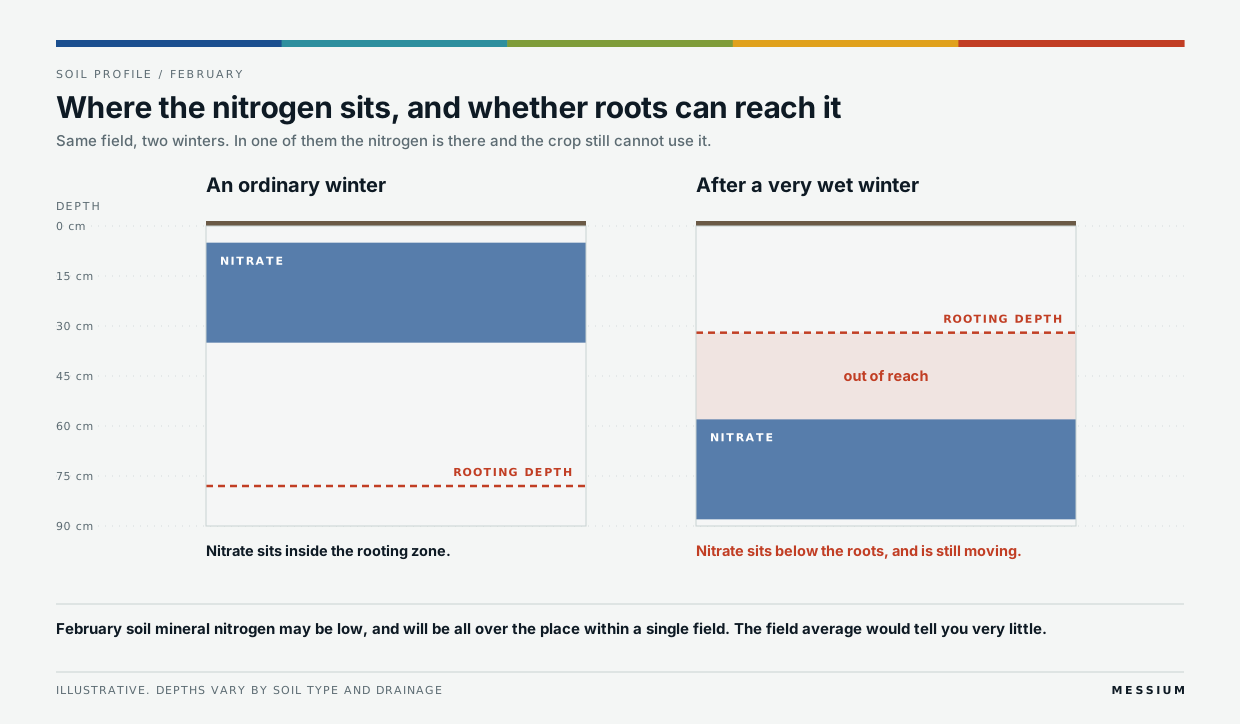
At the same time waterlogged soil has no oxygen in it, so roots stay shallow and the crop never builds the depth it would normally have by spring. If Spring is then dry then a shallow rooted crop has nothing to draw on. Every pass on a very wet soil makes that worse.
None of that is new to anyone who farmed through 2020. N application timing might be led more by drainage than by the calendar.
The first nitrogen application
We expect this to be a very difficult decision in some farms. In a season shaped like this one, both directions of error are expensive. Decisions will need to be made on the weather forecasts at the time, crop nitrogen status and risk/benefit analysis of different options.
Put too much on and, if the field is still wet with more rain to come, the nitrate follows the water down. You either lose it outright or it settles below a shallow root system, where it is unavailable to the plant, and still exposed to the next leaching event before roots ever reach it.
If instead the spring turns dry early, a big first dose on a forward crop builds an oversized canopy very quickly. More leaf area means more transpiration, water stress arrives earlier and harder, lodging risk goes up, and there is not the moisture to support the larger canopy size.
Put too little on and, if leaching really has emptied the soil of nitrogen, then the crop reaches GS30 to GS33 already short. Messium has seen that even one or two weeks of deficiency at that point costs yield that later applications do not fully recover.
Measuring rather than estimating
Potentially unprecedented conditions mean you can't rely on last year's SMN, NDVI or field history since the season could be very different to those that have come before.
The alternative is to measure the crop itself. Hyperspectral satellite imagery reads nitrogen concentration in leaf tissue directly, which gives you a lab equivalent number every 10m. When used with crop growth models and weather forecast data, it tells you which part of which field is about to go short and by how much, weekly, through the spring.
We would say that, obviously. But the reason we think it matters more this year than most is the unprecedented conditions. In a normal year, a mistake in February is recoverable in March. In this kind of season, it might not be.
Where we would put our attention
Get set up to drill early and then let soil moisture decide when, rather than the date. Choose varieties on how their resistance works and their early rate of growth, and assume early rust protection is needed. Be ready to update your nitrogen application plans frequently, based on how the crop and soil are actually looking in February.
If the forecast ends up being wrong and the Autumn, Winter and Spring end up being mostly normal, then most of that is cheap preparation. But preparing for a normal winter that ends up very different from normal could be very expensive.
Violet Hill and Vishal Soomaney work at Messium, which uses hyperspectral & multispectral satellite imagery and crop growth models to measure in-season nitrogen in wheat and produce fertiliser recommendations & variable rate application maps.
Forecast position as of 22 August 2026. The weather is moving quickly, so check the latest forecasts before making decisions.
Sources
- Met Office, An 'unprecedented' El Niño and its implications for the weather forecast, August 2026
- Met Office, El Niño declared for 2026 as Pacific warms, June 2026
- Met Office UK three-month outlook for contingency planners, issued monthly
- National Drought Group statement, August 2026
- Messium assessment of ECMWF seasonal output, August 2026
- NOAA Climate Prediction Center, ENSO Diagnostic Discussion, August 2026
- AHDB, Major winter wheat yellow rust resistance gene fails, 2025
- AHDB wheat yellow rust watch list, and Recommended Lists for cereals and oilseeds 2026/27